
Zinc Picolinate
Superior Zinc Absorption for Optimal Immunity and Mental Clarity*
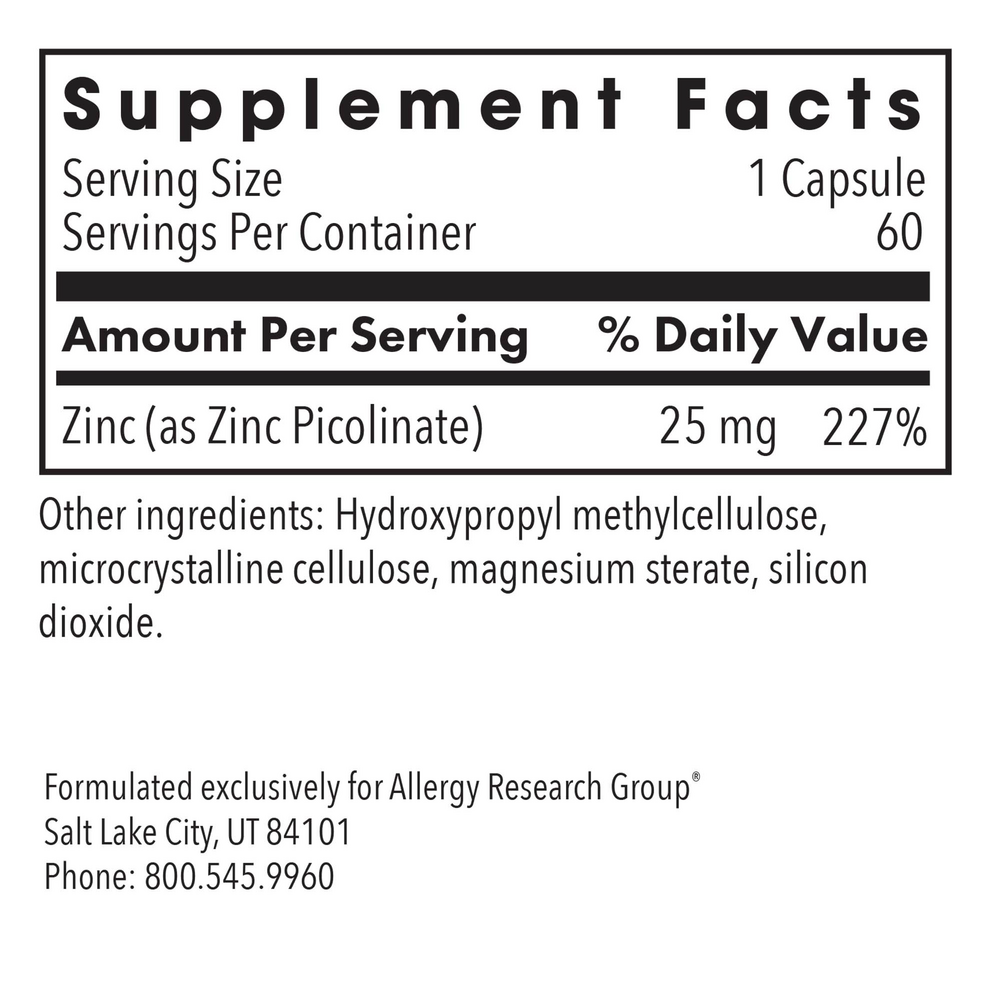
Zinc Picolinate (90 capsules)25 mg delivers zinc in its most clinically absorbed form, shown to be superior to citrate and gluconate. This highly bioavailable format supports immune balance, emotional well-being, cognitive function, and reproductive health.*
How It Works
- Zinc picolinate has been shown to significantly outperform other zinc forms in absorption in human trials.*[13]
- Essential for immune surveillance, zinc helps modulate T-cell maturation, cytokine signaling, and oxidative stress.*[1-2]
- Supports mental health and cognition.*[3-6]
- Supports hormone production and fertility in both men and women.* [7-9]
- Vegetarians and others may benefit from the enhanced uptake of zinc picolinate.*[10][12]
Who It’s For
Ideal for individuals with increased zinc needs, reduced digestive capacity, or specific health goals related to mood, fertility, or immune strength.*
Special Features
Zinc picolinate is the gold standard for absorption, clinically validated and optimized for maximum uptake.*
Dietary Considerations: Gluten free, Dairy free, Soy free, Egg free, Milk free, Tree nut free, Fish free, Peanut free, Wheat free, Corn free, Yeast free, Sesame free, Casein free, Crustacean Shellfish free
Suggested Use: As a dietary supplement, 1 capsule daily with a meal, or as directed by a healthcare practitioner.
Warnings: Keep in a cool, dry place, tightly capped.
References
- Stiles LI, Ferrao K, Mehta KJ. Clin Exp Med. 2024;24(1):38. doi:10.1007/s10238-024-01302-6
- Wessels I, Maywald M, Rink L. Nutrients. 2017;9(12):1286. doi:10.3390/nu9121286
- Petrilli MA et al. Front Pharmacol. 2017;8:414. doi:10.3389/fphar.2017.00414
- Ranjbar E et al. Nutr Neurosci. 2014;17(2):65–71. doi:10.1179/1476830513Y.0000000066
- Sun R et al. Biomolecules. 2022;12(7):1000. doi:10.3390/biom12071000
- de Vargas LDS et al. Nutrients. 2023;15(20):4396. doi:10.3390/nu15204396
- Garner TB et al. Biol Reprod. 2021;104(5):976–994. doi:10.1093/biolre/ioab023
- Prasad AS et al. Nutrition. 1996;12(5):344–348. doi:10.1016/s0899-9007(96)80058-x
- Allouche-Fitoussi D, Breitbart H. Int J Mol Sci. 2020;21(20):7796. doi:10.3390/ijms21207796
- Foster M et al. J Sci Food Agric. 2013;93(10):2362–2371. doi:10.1002/jsfa.6179
- Wegmüller R et al. J Nutr. 2014;144(2):132–136. doi:10.3945/jn.113.181487
- Santos H et al. Clin Nutr. 2020;39(5):1345–1353. doi:10.1016/j.clnu.2019.06.024
- Barrie SA et al. Agents Actions. 1987;21:223–228. doi:10.1007/BF01974946


For Pricing and Purchasing,
View similar products: 1. Preventative Foundational Immune Support, Minerals, Optimizing Immune Function